


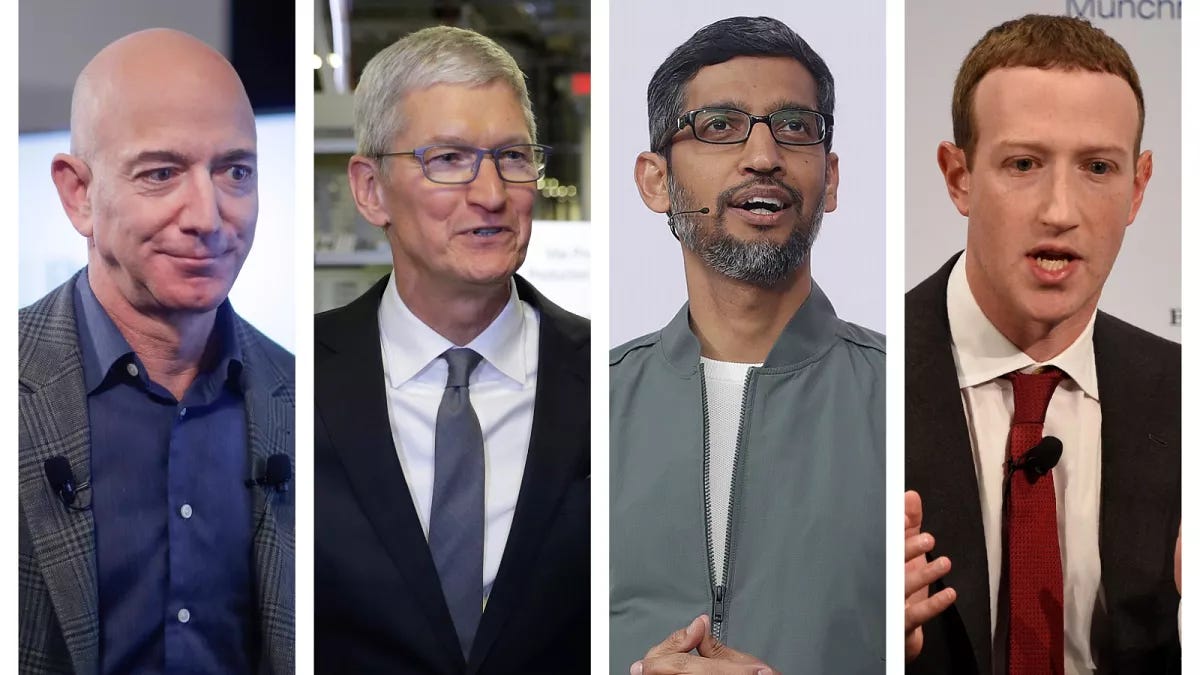
The most evil human beings to have ever lived?
The Admissions Keep Coming
This week brought another bombshell that should surprise no one paying attention: Google admitted to Congress that the Biden administration pressured them to censor Americans and remove content that didn’t even violate YouTube’s policies. The company called this pressure “unacceptable and wrong” and promised to restore thousands of banned accounts.
This follows similar admissions from Facebook/Meta, where Mark Zuckerberg acknowledged that the Biden White House pressured them to suppress content about Hunter Biden’s laptop and COVID-19 discussions. Twitter’s “Twitter Files” revealed similar coordination patterns.
So we now have confirmation from Facebook, Google, and Twitter/X that a sitting administration coordinated with private companies to circumvent First Amendment protections by getting them to do censorship the government couldn’t legally do directly. During an election cycle, no less.
But here’s the kicker: this coordination became legally permissible thanks to Obama’s 2012 repeal of key provisions in the Smith-Mundt Act of 1948. The original law prohibited the State Department from disseminating propaganda intended for foreign audiences to American citizens - creating a crucial firewall between government information operations and domestic media. The 2012 “Smith-Mundt Modernization Act” removed this prohibition, effectively legalizing domestic propaganda operations that had been banned for 64 years.
The timing is telling: this passed right as social media was becoming the dominant information platform, just before the 2016 election cycle when “disinformation” became the excuse for massive censorship operations.
From Mockingbird to Digital Control
To understand how we got here, we need to trace the evolution of government media manipulation. In the 1950s-70s, the CIA ran Operation Mockingbird - systematically infiltrating American media by recruiting journalists, editors, and media executives as assets. They planted stories in major outlets, funded front publications, and could kill stories that threatened “national security” interests.
After the Church Committee investigations exposed Mockingbird in the 1970s, the CIA supposedly ended the program. But they just got smarter about it, shifting to informal relationships and using think tanks as cutouts.
The real game-changer came in 2012 when Obama signed the Smith-Mundt Modernization Act, effectively gutting the 1948 law that had prohibited domestic propaganda operations. This wasn’t just a technical update - it legalized information warfare tactics against American citizens that had been banned for 64 years.
What we’re seeing now with tech platform coordination is simply Digital-Age Mockingbird: the same control mechanisms, just distributed through algorithms instead of newsroom editors.
The “Private Platform” Shell Game
For years, we’ve been told that concerns about Big Tech censorship were overblown because these are “private platforms” that can moderate content however they choose. This defense becomes laughable when we learn these companies were taking direction from government officials to suppress legitimate political discourse.
The government can’t directly censor speech due to First Amendment restrictions, so they outsource it to private companies while maintaining plausible deniability. It’s the perfect end-run around constitutional protections - and it’s been legally permissible since the Smith-Mundt repeal made domestic information operations kosher again.
But even setting aside the government coordination, the “private platform” argument ignores a fundamental reality: when a handful of companies control the primary means of digital communication and commerce, their content decisions can devastate people’s livelihoods and ability to participate in public discourse.
These platforms function as essential public utilities while claiming the rights of private publishers. They’ve created a rigged game where meaningful competition is nearly impossible due to network effects and infrastructure control, then use their monopolistic position to arbitrarily destroy anyone who challenges the prevailing orthodoxy.
The Captured System
The natural response should be: “Well, use the legal system. Break up these monopolies. Regulate them properly.”
Here’s the problem: every institutional remedy has been systematically neutered.
Antitrust enforcement? The recent Google case is instructive. A federal judge found Google was indeed an illegal monopoly, then essentially said “please be nicer” instead of ordering any meaningful structural relief. Microsoft got a slap on the wrist in the 2000s. Facebook was allowed to buy Instagram and WhatsApp despite obvious anti-competitive effects. Amazon continues gobbling up competitors with zero interference.
Congressional oversight? Pure theater. Tech executives get scolded in hearings, then go back to business as usual with zero consequences.
Regulatory agencies? Captured by former Big Tech lawyers and executives through the revolving door.
Electoral politics? Both parties take massive donations from these companies. The same politicians who publicly criticize Big Tech privately coordinate with them on content moderation - a coordination that became legally normalized after 2012.
The courts? Judges have bought into legal frameworks that ignore the broader democratic and economic harms these monopolies create, while the Smith-Mundt repeal provides legal cover for government-platform coordination.
What we’re left with is a system where peaceful reform has become functionally impossible. Every democratic safety valve has been captured, corrupted, or made irrelevant.
The Wealth Disparity Reality
The numbers are staggering and getting worse:
Top 1% owns about 32% of all wealth
Top 10% owns about 70% of all wealth
Bottom 50% owns roughly 2% of all wealth
Median household wealth is around $120k while tech oligarchs measure wealth in hundreds of billions
Consider the specific players:
Bezos: ~$170 billion (built an everything monopoly while treating workers terribly)
Zuckerberg: ~$180 billion (monetizes human psychology and social division)
Cook: ~$2 billion personally, sitting atop Apple’s $3 trillion market cap built on planned obsolescence
At least Elon Musk, whatever his flaws, is actually building things that advance civilization - SpaceX, Tesla, and other ventures that push humanity forward technologically. Compare that to Bezos’s rent-extraction logistics network that crushes small businesses, or Zuckerberg’s engagement algorithms that literally profit from making people angry and divided.
Should anyone be worth a trillion dollars? Absolutely not. That level of wealth concentration is incompatible with democracy. It gives individuals more power than most governments, allowing them to buy politicians, capture regulators, and reshape society according to their personal whims.
The Growing Desperation
What’s particularly alarming is the increasing “nothing left to lose” sentiment spreading across different demographics. This isn’t just affecting fringe groups anymore - it’s hitting middle-class professionals, small business owners, people who used to believe the system worked for them.
When someone’s livelihood gets destroyed by an algorithm, their savings wiped out by medical bills, their future foreclosed by systems they can’t even appeal to - that’s not hyperbole, that’s reality for increasing numbers of Americans. The social contract that says “play by the rules and you’ll get a fair shake” has been systematically shredded.
Recent events - from the healthcare CEO shooting to increasing discussions about violence against corporate executives - suggest we’re approaching a dangerous inflection point. When peaceful change becomes impossible, violent change becomes inevitable. That’s not advocacy; that’s historical pattern recognition.
The Uncomfortable Truth
Here’s what nobody wants to admit: when you honestly assess the track record of peaceful reform against entrenched corporate power, it’s hard to identify realistic solutions that would work within any reasonable timeframe.
What hasn’t worked:
Voting (both parties are captured)
Regulation (agencies are captured)
Antitrust (courts won’t enforce meaningful remedies)
Boycotts (network effects make them impossible)
Building alternatives (they get crushed or bought out)
Congressional pressure (pure theater)
Public criticism (they don’t care about bad PR)
What might actually work:
Mass coordinated platform withdrawal (requires impossible coordination)
State-level action (limited impact against global platforms)
International pressure (EU has some success, but very slow)
Economic collapse of their business models (would hurt everyone)
Genuine political revolution that replaces the captured system entirely
The honest assessment is that peaceful reform requires functional institutions, and ours have been systematically captured. The people in power seem to think they can keep tightening the screws indefinitely while hiding behind security details and regulatory capture.
They might be miscalculating how sustainable that is.
What This Means
The tech oligarchs have created a system where they privatize the profits from user-generated content while socializing the costs of their mistakes onto society. They’ve captured the regulatory apparatus designed to constrain them. They’ve made peaceful reform functionally impossible while continuing to accumulate unprecedented wealth and power.
This is genuinely dangerous for social stability. When legal and democratic channels are systematically blocked, history shows people find other outlets for their frustration. The recent healthcare CEO shooting generated more substantive policy discussion in 48 hours than decades of peaceful advocacy achieved.
Some relatively modest reforms could probably release much of this building pressure:
Automatic financial penalties for bad content moderation decisions
Real antitrust enforcement with structural breakups
Common carrier obligations for large platforms
Algorithmic transparency requirements
Genuine due process protections for users
But they won’t even implement these modest changes, because the current system serves their interests perfectly.
The Choice Ahead
We’re approaching a crossroads where the choice may be between managed reform and unmanaged collapse. The oligarchs seem to believe they can maintain the status quo indefinitely. They may be wrong about that.
Nobody sane wants social instability or violence. But pretending that our current trajectory is sustainable serves no one except those benefiting from the broken system.
The question isn’t whether change is coming - it’s whether that change happens through reformed institutions or through the kind of social breakdown that historically follows when peaceful remedies are systematically eliminated.
The tech oligarchs still have time to choose reform over revolution. Let’s hope they’re smarter than they’ve appeared so far.
The conversation that inspired this piece reflects growing frustration with institutional capture and the apparent impossibility of peaceful reform. These are dangerous waters for any democracy to navigate.