



On September 22, 2025, President Trump announced that his administration would issue warnings about acetaminophen (Tylenol) use during pregnancy, citing potential links to autism in children. The reaction from pregnant women across social media was swift and deeply disturbing.
Rather than carefully considering the health implications for their unborn children, some pregnant women began posting videos of themselves deliberately taking Tylenol specifically to “rebel” against Trump’s announcement. One woman, claiming to be 28 weeks pregnant, posted: “You know what I’m gonna take some Tylenol with acetaminophen and my baby won’t have autism” while laughing.
This isn’t political disagreement. This is something far more troubling: the complete override of basic maternal protective instincts by reflexive political opposition.
The Medical Reality
Medical experts immediately expressed alarm about this response. Acetaminophen has a therapeutic index of only 10, meaning the difference between an effective dose and a dangerous dose is perilously small. For comparison, morphine has a therapeutic index of 70, and Valium 100. Both require prescriptions, yet acetaminophen is sold over-the-counter.
Acetaminophen overdose during pregnancy can cause severe liver and kidney damage to both mother and baby. The drug crosses the placenta, and fetal liver cells can suffer severe damage from toxic overdoses. Taking medication specifically to make a political point, especially during pregnancy, puts innocent lives at risk for no medical benefit whatsoever.
What Johnson & Johnson Knew And When They Knew It
But here’s where this story takes a darker turn. While pregnant women were risking their babies’ health to oppose Trump, internal documents reveal that Johnson & Johnson, Tylenol’s original manufacturer, has been aware of potential autism risks for over a decade.
As early as 2008, J&J began receiving queries from consumers and physicians about possible links between acetaminophen and autism. Andre Mann, J&J’s Office of Consumer Medical Safety Lead, wrote internally: “Not much choice but to consider this a safety signal that needs to be evaluated.”
By 2012, Leslie Shur, head of J&J’s drug monitoring division, was receiving alerts about acetaminophen and autism concerns. The issue may have reached then-CEO Alex Gorski by 2014.
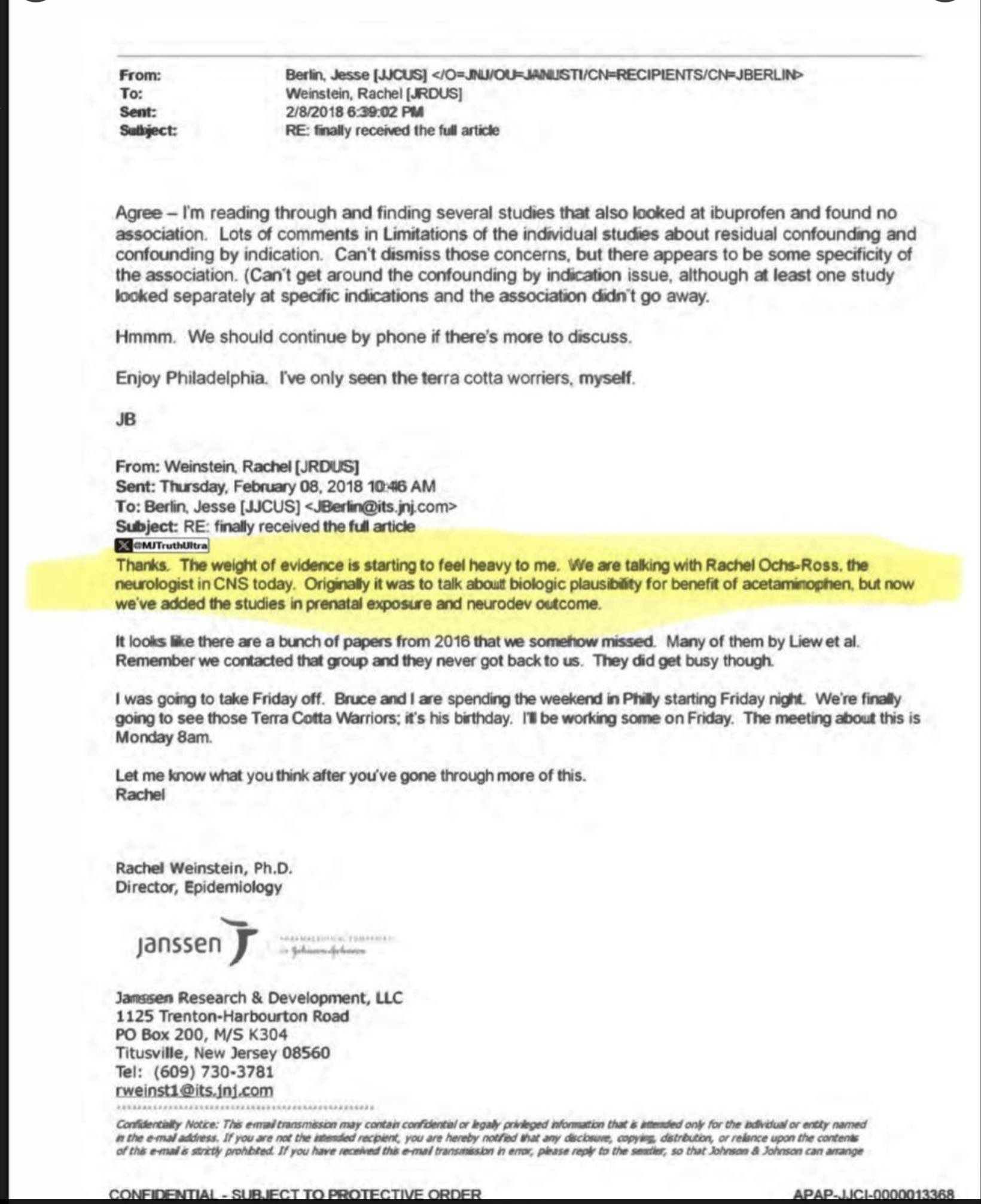
The most damning evidence came in 2018, when Rachel Weinstein, a senior epidemiologist at the company, wrote internally that “the weight of the evidence is starting to feel heavy to me.” A confidential internal presentation that same year acknowledged that observational studies showed a “somewhat consistent” association between prenatal Tylenol exposure and neurodevelopmental disorders.
The Public Deception
While privately acknowledging these concerns, J&J’s public messaging told a completely different story. The company continued aggressive marketing campaigns targeting pregnant women, including Mother’s Day advertisements prominently featuring expectant mothers.
From 2020 to 2023, the company engaged in “social listening,” monitoring online conversations about Tylenol and autism, yet made no efforts to warn pregnant women about potential risks.
Today, Kenvue (which now owns the Tylenol brand) states on its website: “credible, independent scientific data continues to show no proven link between taking acetaminophen and autism.” This directly contradicts their own internal acknowledgments spanning over a decade.
The Perfect Storm of Irresponsibility
What we witnessed in September 2025 represents a perfect storm of institutional failure and individual recklessness:
A pharmaceutical company that knew about potential risks but prioritized profits over public health
Pregnant women so consumed by political opposition that they willingly endangered their unborn children
A media environment so polarized that reasonable health discussions become political warfare
The pregnant women taking Tylenol to “own Trump” represent something unprecedented: political derangement so complete that it overrides the most basic biological drive of protecting one’s offspring.
The Broader Implications
This incident raises uncomfortable questions about the state of our political discourse. When opposition to a political figure becomes so reflexive that pregnant women will risk their babies’ health simply to spite him, we’ve crossed into dangerous territory.
If Trump announced that suicide was harmful, would some people seriously consider ending their lives just to prove him wrong? Based on the Tylenol rebellion, that possibility no longer seems absurd.
The real tragedy isn’t just the corporate malfeasance, though J&J’s decade-long deception while marketing to pregnant women is unconscionable. The real tragedy is watching maternal instinct, honed by millions of years of evolution, completely overridden by political programming.
Our children deserve better than being used as props in political theater. And pharmaceutical companies that hide known risks while targeting vulnerable populations deserve far more scrutiny than they’ve received.
The Tylenol rebellion of 2025 will be remembered not as a moment of resistance, but as a cautionary tale about what happens when politics becomes more important than protecting the innocent.