


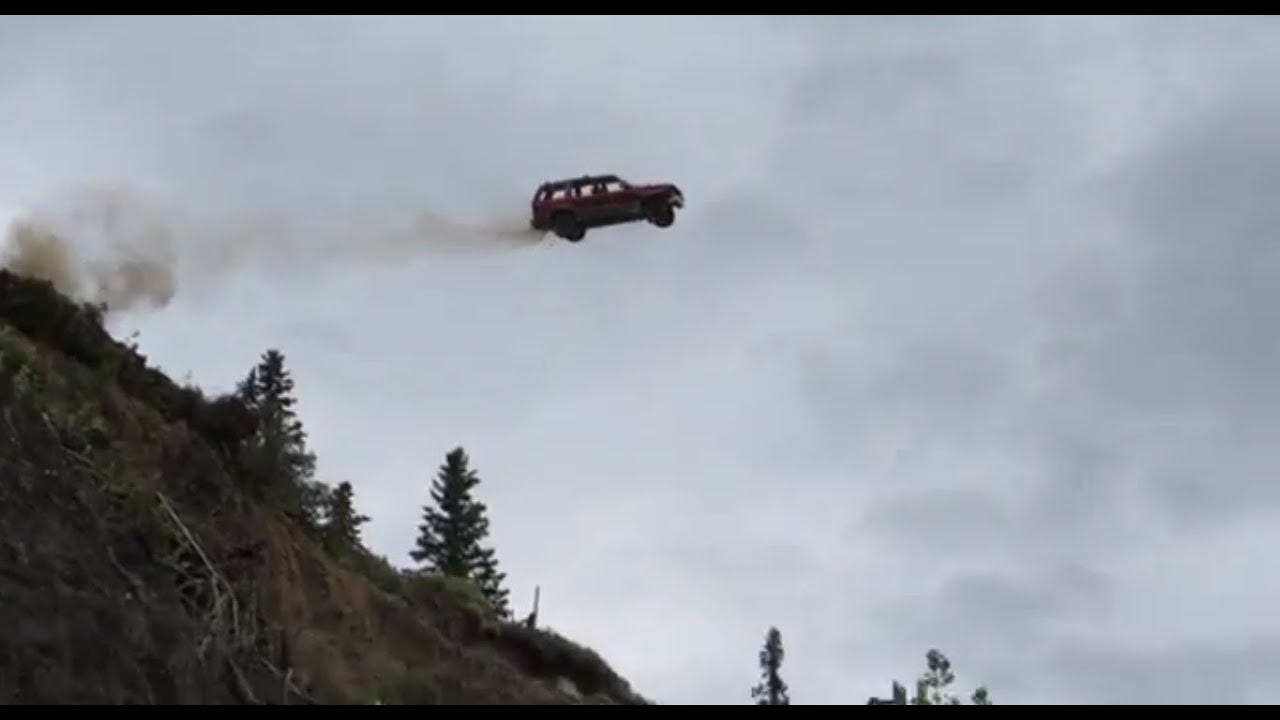
The most dangerous moment for any society isn’t when people disagree, it’s when those in control floor the accelerator toward the cliff while slashing the brakes, leaving no way to stop the inevitable crash.
The Metaphor of a Nation in Peril
Imagine American society as a speeding car hurtling toward a cliff of instability and collapse. The drivers: political elites, media moguls, and institutional gatekeepers from both left and right, have their foot slammed on the gas, fueling polarization through inflammatory rhetoric, selective outrage, and policies that deepen divides. Worse, they’ve cut the brakes: eroding trust in elections, courts, protests, and dialogue by allowing bias, capture, and failure to dominate. Recent events aren’t just tragedies; they’re accelerators that rev the engine and deliberate sabotage that disables safeguards. On both sides, these incidents heighten desperation, making peaceful change feel impossible.
Key Incidents Accelerating the Divide
A surge in political violence in 2025-2026 has turbocharged this trajectory, with data from organizations like CSIS and the University of Maryland showing a historic high, over 150 politically motivated attacks in the first half of 2025 alone, spanning ideologies. Here’s how specific events from both sides exemplify the acceleration and brake-cutting:
Left-leaning acceleration and brake cuts: The assassination of conservative activist Charlie Kirk on September 10, 2025, at Utah Valley University acted as a massive throttle boost for right-wing rage. The 22-year-old suspect’s alleged ideological motives (linked to anti-fascist sentiments) amplified narratives of unchecked left extremism, provoking backlash like increased scrutiny on online discourse and lawsuits over free speech. This not only heightened tensions but cut brakes by exposing institutional failures, slow federal responses and perceived media downplaying allowed division to fester without accountability. Similarly, the recent attack on Vice President JD Vance’s residence around January 8, 2026, (details still emerging but tied to anti-administration protests) further accelerates conservative fears of targeted left-wing violence, while cutting brakes through partisan smears (e.g., Vance’s own rhetoric labeling opponents as networks inciting chaos, mirroring how elites dismiss cross-ideological reform efforts).
Right-leaning acceleration and brake cuts: The fatal shooting of Renee Nicole Good by an ICE agent on January 7, 2026, in Minneapolis exemplifies right-wing enforcement as an accelerator for left-wing outrage. Labeled “domestic terrorism” by the Trump administration despite disputes over footage showing no clear imminent threat, it sparked nationwide protests (including in Portland, where similar federal operations led to clashes). This revs up progressive narratives of state overreach, especially under mass deportation policies, while cutting brakes, selective video releases, erode faith in investigations, making impartial justice seem rigged. The April 2025 arson attack on Pennsylvania Democratic Governor Josh Shapiro’s residence further exemplify this: they heighten political tensions, while institutional responses (delayed convictions, partisan finger-pointing) sabotage any chance for de-escalation or bipartisan reforms.
These aren’t anomalies. CSIS reports show left-wing incidents outpacing right-wing for the first time in 30 years in 2025 (five left vs. one right in the first half), but fatalities remain higher from right-wing violence historically. In early 2026, warnings from experts like those at the Soufan Center predict more left-targeted attacks on immigration enforcement, while right-driven policies fuel counter-violence, a vicious cycle where each side’s actions accelerate the other’s extremism.
The Unintended (Perhaps Intended) Consequences of Extreme Policies
Far-left governance in progressive strongholds like Seattle provides a chilling case study in how policies can accelerate societal decay while cutting the brakes on recovery. Following the 2021 Washington Supreme Court Blake decision, which decriminalized simple drug possession, Seattle’s city council embraced a “compassionate” approach: diverting public drug use to programs like LEAD (Law Enforcement Assisted Diversion) instead of arrests. The goal was to treat addiction as a health issue, reducing incarceration and stigma, especially for marginalized communities.
But the unintended consequences have been devastating, turning good intentions into urban nightmares. Recent studies, including a 2025 CrimRxiv analysis of decriminalization in Washington and Oregon, reveal stark crime spikes: Seattle saw violent crime rise +40%, robberies +92%, and property crimes like car thefts +154%. Overdoses surged too: fentanyl deaths jumped 50% in 2024-2025, per local reports, as open-air drug markets flourished without deterrents. Businesses fled downtown amid theft and disorder, tourism tanked, and neighborhoods became “almost unlivable,” as residents lamented in KUOW-Seattle reports. Without robust treatment funding (despite a $1 billion homelessness budget skewed toward housing over rehab), users cycle through streets, fostering violence, trafficking, and despair that ripple into broader societal harms.
This mirrors the right’s aggressive enforcement in cases like Good’s shooting, where law and order policies accelerate division by prioritizing force over de-escalation. Both extremes erode trust: left-leaning permissiveness enables chaos, while right-leaning crackdowns spark backlash.
Now, the darker perspective, one that smacks of conspiracy but demands scrutiny to force open eyes: Are these far-left policies truly bungled, or intentionally designed to promote self-destruction? Critics in conservative circles argue they embody “suicidal empathy,” where lax enforcement on drugs, borders, and crime lets addiction and violence cull vulnerable populations: the poor, addicts, minorities hardest hit by fentanyl flows. It’s a passive, socially acceptable form of genocide: easier than direct extermination because it’s cloaked in “compassion.” Fentanyl does the killing, protests get dismissed as riots, and elites avoid blame while urban cores depopulate for redevelopment or control. Echoing Canada’s MAID expansions (from terminal illness to poverty-driven suicides), Seattle’s approach devalues lives under progressive rhetoric, blaming drugs over systemic failures like inequality. Incompetence or malice? The pattern, defunding police (Seattle cut SPD 20% in 2020-2021, causing response delays) while ignoring root causes fuels the theory that it’s deliberate, dividing us to conquer while we kill ourselves and each other.
The Bipartisan Experience of a Rigged Ride
Both left and right now feel trapped in this doomed vehicle:
Conservatives/right-leaning Americans see events like Kirk’s assassination and the Vance attack as proof of left radicalism tolerated by elites, with brakes cut via biased media (quick mockery of victims) and slow justice (ongoing probes without closure). Policies like Seattle’s decriminalization amplify this, enabling the chaos that breeds anti-conservative violence.
Progressives/left-leaning Americans view Good’s death and Hortman’s killing as state or extremist violence unchecked, with brakes slashed through rhetoric (smearing victims as terrorists) and failed oversight (FBI investigations favoring power). The darker flip: right-wing border crackdowns mirror left permissiveness, accelerating deaths via enforcement rather than neglect.
Institutions meant to steer us safely: elections, courts, protests, are undermined: Polarized media fuels the gas pedal, captured agencies ignore root causes, and bipartisan elites prioritize division over fixes.
The Crossroads: Pump the Brakes or Plunge?
No one wants the crash. Yet with wealth concentration (top 1% owning ~32%), eroding opportunities, and “nothing left to lose” spreading, history warns of breakdown when peaceful paths vanish.
Modest reforms could still pump the brakes: transparent probes (full footage, no smears), de-escalation policies, bipartisan condemnation of violence, and addressing grievances like inequality and enforcement fairness, reversing extremes like Seattle’s unchecked decriminalization.
But the current drivers: elites flooring it for POWER and MONEY… serve only themselves. Societies don’t survive when left, right, and center conclude the only way out is to jump or crash. Wake up: the “conspiracies” might just be the uncomfortable truths staring us down. The choice is ours: restore the brakes through justice, or watch the cliff approach.
I don’t want to die. Do you? Because that’s where we are being inexorably driven towards.