


On Thursday evening, 25 June 2026, police were called to a house on Pyrcroft Road in Chertsey, Surrey. Inside, they found a two-year-old girl. Dead. Kevin Kerjean, 31, a French national born in the Central African Republic, was also found at the address, treated for injuries, and arrested. By Saturday he had been charged with murder, rape of a child under 13, and sexual assault of a child under 13. He appeared at Guildford Magistrates’ Court and was remanded in custody.
That is the factual architecture of the case. What happened next: in the comment sections, in group chats, in the space where British people process collective horror… is what this article is about.
The phrase appeared almost immediately. It had appeared before, in different threads, under different atrocities. But this weekend it achieved a kind of critical mass. In comment after comment, attached to the Chertsey news, to the coverage, to everything adjacent:
We shouldn’t have to live like this.
This is not an emotional reaction. Or rather, it is an emotional reaction and it is something else. Something colder. Something diagnostic. Pay attention to what the phrase actually says, because it isn’t what it looks like.
The Sentence Is Not About Grief
When people say we shouldn’t have to live like this, they are not expressing sorrow. Sorrow sounds like this is terrible or that poor child or what kind of monster does this. Those are grief responses. They’re directed at the event.
We shouldn’t have to live like this is directed at the system.
The word “live” is doing heavy structural work. Not this shouldn’t happen, that would be about the crime. Not they should be punished, that would be about justice. “Live like this” means the speaker has accepted that these events happen, has incorporated that knowledge into their model of daily existence, and is now passing judgment on the environment that produces that reality.
This is the language of people exiting a contract.
The social contract. Rousseau’s version, the one that actually governs how modern states function, is not complicated. You surrender certain freedoms, certain capacities for private vengeance, certain rights to self-determined security. In return, the state provides protection. It maintains the conditions under which ordinary life is possible. Children can exist in their homes. Streets are (broadly) safe. The catastrophic is rare.
The contract is not a formal document. It doesn’t need to be. It runs on something more durable than law: the daily, unspoken assumption that the state is keeping its end of the bargain. That assumption is trust. And trust is not rebuilt with press releases.
When enough people say we shouldn’t have to live like this, they are not petitioning for change. They are announcing, collectively, that the assumption has failed. Many citizens increasingly perceive the contract to already be in breach.
No institution can prevent every atrocity. The question is whether citizens believe institutions respond consistently afterward. That distinction matters. A society does not lose faith because evil exists; it loses faith when people conclude that protection, accountability, and justice are applied unevenly or too late.
What Has Actually Happened
The Chertsey case is the detonator. The powder keg has been accumulating for years, and there are two loads in it that account for the particular fury of this moment.
The first is the pattern of child sexual violence and the state’s visible indifference to it.
One month before the Chertsey murder, three teenage boys stood in Southampton Crown Court having been convicted of raping two girls, 14 and 15 years old, in separate attacks in Fordingbridge, Hampshire. The attacks were filmed. One allegedly involved a knife. Judge Nicholas Rowland sentenced all three to youth rehabilitation orders: non-custodial, community-based, no prison. His reasoning, delivered in open court, was that he wanted to “avoid criminalizing these children unnecessarily.”
The victims are destroyed by what was done to them. That destruction is permanent. It lives in their bodies, their sleep, their relationships, every first date they’ll ever try to have. The men who did it walked out of court.
One victim said the sentence “hit like a rock straight in my face.” That response was more restrained than most of the country’s.
Politicians across the spectrum expressed outrage. Keir Starmer called it “distressing” and “appalling.” The case was referred to the Court of Appeal. More than 200,000 people signed a petition calling for the judge to face investigation. The Attorney General is reviewing the sentences.
None of that undoes the original message the sentence sent: your suffering is a lesser priority than his comfort.
This is not an isolated data point. It is a node in a network that British people have spent years mapping, whether consciously or not. The pattern includes the grooming gang scandals, where the state’s failure was not merely operational but deliberate, managed, suppressed… and extends forward to every subsequent case where institutional protection of process outweighed protection of children.
When a new atrocity arrives… a two-year-old girl, in her own home, done to death, people don’t experience it as an isolated event. They experience it against that accumulated backdrop. The rage is not proportionate to one case. It’s proportionate to the whole file.
The second load is the immigration dimension, and it requires precision rather than avoidance.
Kevin Kerjean is a French national, born in the Central African Republic. That information was in the public domain within 24 hours of his court appearance. In comment sections, it spread faster than the charges themselves.
There is a version of the response to this that is wrongly labeled as racist, that uses the defendant’s origin as evidence of an inherent racial predisposition toward violence, and from there to conclusions about immigration categorically.
But there is another version of the response that is not being accurately named by those who want to dismiss it. It goes like this:
The British state has, over a sustained period, demonstrated that it applies different standards of institutional courage depending on the political costs of applying them. It prosecuted EDL members while allowing grooming gang investigations to stall for years because the perpetrators were predominantly from African/Middle Eastern Muslim communities and officers feared being accused of racism. It categorized legitimate public concern about migration as right-wing extremism while presiding over an asylum and immigration system with chronic accountability failures. It told the public repeatedly, through enforcement patterns rather than policy documents, that the protection of institutional reputation was worth more than the protection of people.
That is not a “racist” argument. It is an argument about institutional bias in the application of state power. It is an argument about which victims the state moves for quickly and which ones it moves for slowly (or not at all). It is at its core, an argument about equal protection, and it is being made, loudly and with genuine grievance, by people who are not bigots and do not deserve to be treated as if they are.
The state has materially contributed to this problem. Every time it failed to apply equal force, equal investigative urgency, equal prosecutorial will, equal judicial seriousness… it confirmed for ordinary people that the system had a thumb on the scale.
When a man with foreign origins is charged with the murder and rape of a British toddler, the public reaction contains both the racism that should be challenged and the legitimate institutional grievance that should be heard. Flattening both into the same category, as too many commentators will do this week, doesn’t protect anyone. It just ensures the legitimate grievance finds other, uglier expressions.
The Numbers Underneath the Noise
The anger in those comment sections is not irrational. It is, in fact, tracking something real.
Only 49% of the British public now rate their local police as doing a good or excellent job! Down from 62% a decade ago, a continuous downward trend. Confidence in courts dropped 12 percentage points in a single year, 2024 to 2025, the largest single-year decline Gallup has ever recorded for that measure. Victim satisfaction with how police handled their cases sits at 55%, the lowest in 20 years, 20 points below where it was in 2013/14. Over a third of the public say they wouldn’t even bother reporting a crime, believing the police would do nothing.
Sit with that for a minute.
These are not the statistics of a population that trusts its institutions. These are the statistics of a population that has stopped expecting to be protected, and is now simply waiting to see what comes next (or takes action on their own, but that is its OWN article completely). This shift is already appearing in popular culture. The recent film Citizen Vigilante is less an anomaly than a symptom.
The Onward think tank documented this in granular detail in their Anti-Social Contract report: a population facing stagnant wages, housing unaffordability, declining public services, and a police force it has substantially lost faith in. Seventy percent believe police have “given up” on low-level crime. These are the conditions in which we shouldn’t have to live like this goes from a protest phrase to a worldview.
What Happens When People Exit the Contract
The historical record on this is not ambiguous. When populations decide, at scale, that the state has stopped holding its end of the bargain on basic protection, the alternatives they reach for are not abstract.
Some reach for political vehicles, which is precisely what has been happening in Britain. Reform UK’s rise is not primarily ideological. It is in large part, a vessel for people who have decided that the established parties do not take their security seriously. That is a specific emotional and political state: not I disagree with the policy but I am no longer being protected and the people in charge do not seem to notice or care.
Some reach for something less mediated. Vigilantism, community enforcement, the decision to handle things without deference to institutions that have demonstrated they cannot be trusted. This has always been the substrate beneath British society’s surface calm, and it does not take much to activate it.
And some simply withdraw… from public space, from civic engagement, from the investment of any emotional energy in the idea of a shared national project. This is the quieter damage. The one you don’t see until you notice that nobody is showing up for anything anymore, that the social ligaments have just quietly dissolved.
We shouldn’t have to live like this contains all three of these futures in latent form. It is the phrase people say before they do something, before they vote for something they’d previously considered extreme, before they take matters into their own hands, before they stop caring about the commons altogether.
The Inverted Contract
Somewhere, a woman was robbed at knifepoint. She got back in her car and ran over her attacker. Multiple times. Then she retrieved her bag and drove away:
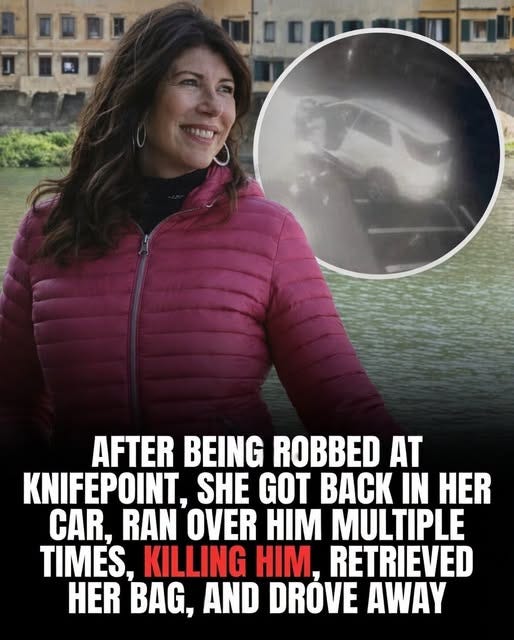
The comment sections loved her. Not because people are bloodthirsty, though some are, but because she did what the state has repeatedly failed to do. She produced a consequence. Immediately. Proportionately, in the eyes of people who have watched child rape rewarded with rehabilitation orders and a sympathetic judicial monologue about the perpetrators’ futures.
She got her bag back. That detail is doing more emotional work than it appears to. Getting your bag back means the predator didn’t win. It means the transfer of power was reversed. It means something that almost never happens in the official machinery happened here, in a car park, in thirty seconds, by a woman who decided the threat radius hadn’t cleared and acted accordingly.
But here’s what nobody said in those comment sections.
Nobody said “she’ll be fine.” Nobody said “the law is clearly on her side.” Nobody said “open and shut self-defense, move on.”
What they said was: if I’m on the jury, she walks.
That conditional is the tell. “If I’m on the jury” only makes sense as a statement if you’ve already assumed prosecution is coming. It’s a backup plan. It’s someone pre-positioning themselves at the last firewall of a system they’ve already decided will fail her… not because the law doesn’t protect her, but because they no longer believe the law will be applied to protect her.
Work through the legal architecture and the self-defense case is strong. A lethal weapon was deployed in the commission of a violent felony. She used the only defensive tool available to her. She applied force until the threat was neutralized which is correct doctrine, not excess. He remained within threat radius throughout. She recovered stolen property after the threat had passed. Depending on jurisdiction, this may not even be a difficult case.
None of that matters to the comment section. Not because they’ve done the legal analysis and rejected it, but because they haven’t done the legal analysis at all. They’ve skipped straight to the assumption that the system will prosecute her anyway. That assumption is so embedded it doesn’t even get stated! It’s the invisible premise underneath “if I’m on the jury.” The jury isn’t their preference. It’s their contingency.
This is the sharpest edge of what broken trust actually produces.
It’s not just that people believe the state won’t protect them from predators. That’s the first stage, and Britain passed through it some time ago. The second stage is what the comment sections are now revealing: people have come to believe the state will actively move against victims who protect themselves. That the machinery built to enforce the contract will be turned on the people the contract was supposed to serve.
The contract hasn’t just lapsed. In the public imagination, it has inverted.
A system people believe to be inverted produces specific behaviors. People don’t just disengage, disengagement is what you do when the system is merely useless. When people believe the system is actively hostile, they route around it entirely. They make private arrangements. They decide in advance which laws they will and won’t cooperate with. They pre-commit to jury nullification for victims and private enforcement for predators, in a mental framework that is already fully developed before any specific case arrives.
That framework is not fringe. Read the comment sections. It is the default operating assumption of a substantial portion of the British public, cutting across class and geography and political affiliation. The specific details vary. The underlying model is the same: the system protects itself, punishes the wrong people, and cannot be trusted to do otherwise.
When enough people are running that model, the rule of law doesn’t collapse dramatically. It hollows out quietly. People comply with laws they agree with and route around the ones they don’t, using whatever tools are available… jury positions, community pressure, selective reporting, silence. The edifice stands. The load-bearing capacity disappears.
And somewhere in a courtroom, a judge explains that he didn’t want to criminalise the children who filmed themselves raping a fifteen-year-old, and another brick comes out of the wall, and nobody who needed to hear it is listening anymore.
The Diagnosis the State Cannot Hear
The British government’s instinct, in the face of this phrase and what it represents, will be to manage the optics. To say the right things about the Chertsey case, to reiterate that the Fordingbridge sentences are under review, to announce some initiative or review or task-force that demonstrates concern.
That instinct is not entirely wrong. But it is NOT sufficient. Because the problem is not that the public feels unprotected. The problem is that the public is unprotected, or protected inconsistently, or protected in ways that demonstrably prioritize institutional comfort over actual victims… and they have noticed.
The phrase we shouldn’t have to live like this will circulate through comment sections for a few more days and then recede. The next atrocity will produce it again. And the next. Each time it appears, it will be carrying a slightly larger payload of accumulated loss of faith.
The institutions being held in contempt by that phrase have a narrow window in which the contempt is still redeemable. In which demonstrable change, in who gets protected, how quickly, with what seriousness… could begin to reverse the trust data.
That window is not open indefinitely.
A two-year-old girl is dead in Chertsey. Her name hasn’t been released. She existed for two years in a world that was supposed to protect her and did not.
We shouldn’t have to live like this is the sound of a country realizing that the protection was never as solid as it looked. That the contract has terms the state has been quietly failing to meet for a long time. And that people are now keeping score.
Comments are open. Push back hard if you think I’ve got the framing wrong.
You are correct -- the social contract that heretofore had been present in the UK, is gone. They have been trying to do it here in the US as well. Thankfully, we all have the 2A to protect ourselves. And our current administration is all for allowing us to use it (although some states are still in the mode of accusing the victims instead of the perps).
I'm not sure what is going on on the left in this country, but it's not good.