


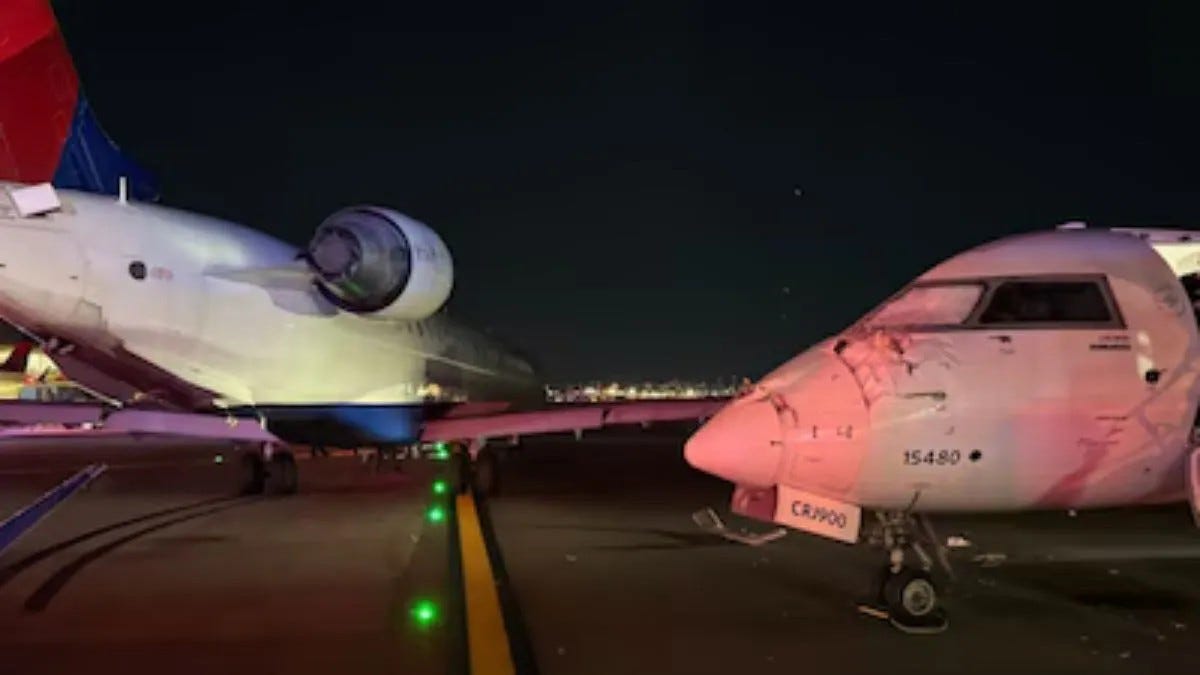
The NY LaGuardia Collision: A System Breaking Down
On the evening of October 1, 2025, passengers aboard two Delta Connection jets experienced what aviation experts euphemistically call a “low-speed collision.” Endeavor/Delta 5155, preparing to depart for Roanoke, Virginia, was taxiing when its wing slammed into the nose of Endeavor/Delta 5047 as it taxied to its gate after arriving from Charlotte, North Carolina.
“Their right wing clipped our nose and the cockpit,” the pilot radioed to air traffic control, his voice unnaturally calm as he reported shattered windscreens and damaged instruments. “We got absolutely smashed,” a passenger told reporters later, describing how everyone was “shot forward” by the impact.
One flight attendant was injured. Ninety-three people could have died.
The Federal Aviation Administration noted that air traffic control had instructed Flight 5155 to “hold short and yield to the other aircraft” before the collision. Someone didn’t follow instructions, or couldn’t see what was happening in the darkness of a busy airport at night.
This wasn’t an anomaly. It was October 1st, and it was already the second major ground collision involving commercial aircraft at a major U.S. airport in 2025.
A Death Toll We’re No Longer Counting
Just eight months earlier, on January 29, 2025, the deadliest U.S. aviation disaster in over a decade unfolded in clear skies over Washington, D.C. American Airlines Flight 5342 collided with an Army Black Hawk helicopter just short of the runway at Reagan National Airport. All 67 souls aboard both aircraft were lost as they plunged into the frigid Potomac River.
The weather was perfect. Visibility was 10 miles. Both aircraft were following routine procedures.
What wasn’t routine was the state of Reagan National’s air traffic control tower, ”not normal” in the words of investigators, with the helicopter controller duties combined with runway operations and staffing levels nearly a third below target.
Just one day before the fatal collision, another regional jet had to abort its landing at Reagan National due to a close call with a military helicopter. The warning signs were flashing red. Nobody was watching.
The Numbers Don’t Lie: America’s Aviation Crisis
In fiscal year 2024, the FAA recorded 1,115 runway incursions, dangerous situations where aircraft, vehicles, or people ended up where they shouldn’t be on active runways. That’s more than three potentially deadly situations every single day. Add in 183 “operational incidents” where air traffic controller actions resulted in planes coming closer than permitted to other aircraft or obstacles.
Consider the recent parade of near-catastrophes:
Austin, February 2023: A FedEx cargo plane came within 150 feet of landing on top of a Southwest 737 sitting on the same runway through thick fog
JFK, January 2023: A Delta flight aborted takeoff as an American Airlines plane crossed the same runway
JFK, April 2024: Swiss Air was cleared for takeoff while four other planes were simultaneously cleared to cross the same runway
San Diego, February 2024: A Japan Airlines flight mistakenly taxied onto the main runway as a Delta flight was cleared to land
LaGuardia, May 2025: An American Eagle flight had to abort takeoff when a United jet was still on the runway
Washington DC, January 2025: 67 people dead in a mid-air collision
LaGuardia, October 2025: Two Delta jets collide on the taxiway
Each incident follows a familiar pattern: miscommunication, poor visibility, controllers making split-second decisions under crushing pressure, and aircraft in places they shouldn’t be. But the deeper question is one nobody in power wants to answer: How did we get here?
Part I: When Politics Replaced Competence in the Tower
To understand today’s crisis, you have to go back to 2013, when the Obama administration’s FAA decided to revolutionize air traffic controller hiring. But they weren’t focused on safety, they were focused on demographics.
The new system, implemented in 2014, replaced straightforward aptitude testing with a “biographical assessment” that prioritized factors like employment history and geographic location over actual ability to handle the life-or-death stress of air traffic control. Applicants with years of relevant experience, including military veterans and graduates of FAA-approved aviation programs, found themselves automatically disqualified in favor of candidates who scored higher on biographical factors that had nothing to do with keeping planes from crashing into each other.
The National Air Traffic Controllers Association called it “an abomination.” A class-action lawsuit alleged the system was designed to game diversity metrics rather than identify the best candidates. Internal FAA documents from 2013 posed the question starkly: “How much of a change in job performance is acceptable to achieve what diversity goals?”
The answer should have been: None. Zero. Not one iota of degraded performance when the margin for error is measured in seconds and the cost of failure is measured in bodies.
The Staffing Crisis Gets Real
The results were predictable. By 2025, the FAA was operating with a chronic shortage of air traffic controllers. Major airports like Reagan National were running nearly a third below targeted staffing levels. Controllers at facilities across the country were working mandatory overtime, six-day weeks, handling complex traffic patterns while fatigued.
When the Austin incident happened in February 2023, the controller handling the runway had been alone, managing both the runway and another position simultaneously. At Reagan National in January 2025, helicopter operations were combined with runway controller duties in what investigators described as an abnormal configuration.
You get what you select for. The Obama administration selected for biographical diversity. What they got was a system where understaffed, overworked controllers are playing three-dimensional chess with passenger jets while working their eighth consecutive day.
The Trump administration eliminated the biographical assessment in 2018, but the damage was done. Thousands of qualified candidates had already been turned away. The FAA estimates the controller shortage could persist into the 2030s.
Part II: When Boeing Was Allowed to Grade Its Own Homework
While the FAA was experimenting with controller hiring, they were running a parallel experiment in regulatory capture that would prove even deadlier.
In the 2000s, under industry pressure to speed up aircraft certification and reduce costs, the FAA created the Organization Designation Authorization (ODA) program. The concept was simple, if insane: allow aircraft manufacturers to essentially certify their own planes, with minimal FAA oversight.
By 2009, early in the Obama administration, the ODA program was fully implemented. Boeing was given broad authority to conduct safety assessments on its own aircraft through the program, with FAA engineers reduced to reviewing paperwork rather than conducting rigorous independent testing.
The consequences would be written in blood.
The 737 MAX: Corporate Greed Meets Regulatory Failure
In 2011, Boeing faced a problem. Airbus was stealing market share with its fuel-efficient A320neo (new engine option). Boeing needed to respond quickly, but designing a new aircraft would take years and billions of dollars. So they chose the cheaper, faster option: retrofit the 1960s-era 737 airframe with bigger, more fuel-efficient engines.
There was a problem. The new engines changed the aircraft’s handling characteristics, making it prone to dangerous nose-up attitudes that could stall the plane. Boeing’s solution was the Maneuvering Characteristics Augmentation System (MCAS) software that would automatically push the nose down if it detected a potential stall.
Under the ODA program, Boeing’s own engineers assessed MCAS and determined it didn’t require additional pilot training. The FAA rubber-stamped their conclusion. Airlines were told pilots could learn about MCAS through an iPad course. Many pilots didn’t even know the system existed.
October 29, 2018: Lion Air Flight 610 crashed into the Java Sea shortly after takeoff from Jakarta. All 189 people aboard died. A faulty sensor fed bad data to MCAS, which repeatedly forced the nose down. The pilots fought the aircraft for eleven minutes before it slammed into the ocean at 500 mph.
March 10, 2019: Ethiopian Airlines Flight 302 crashed six minutes after takeoff from Addis Ababa. All 157 people aboard died. Same faulty sensor. Same MCAS death spiral. Same pilots fighting a system they didn’t understand until the aircraft hit the ground.
346 people dead because Boeing prioritized speed and profit over safety, and because the FAA had abdicated its responsibility to provide rigorous independent oversight.
Internal Boeing messages revealed engineers knew about MCAS problems. “This airplane is designed by clowns who in turn are supervised by monkeys,” one engineer wrote. Another said the aircraft was “designed by clowns.”
But the FAA, having ceded its authority to Boeing through the ODA program, didn’t catch it.
The Bleeding Doesn’t Stop
Even after the MAX disasters forced changes to the certification process, Boeing’s quality control problems persisted, because the culture of prioritizing production over safety remained embedded.
January 5, 2024: Alaska Airlines Flight 1282, a 737 MAX 9, lost a door plug at 16,000 feet. The plug, a panel that covers an unused emergency exit, simply blew out of the fuselage mid-flight. Passengers’ phones were sucked out of the cabin. A child’s shirt was ripped off. Only the fact that the adjacent seats were unoccupied prevented deaths.
Investigators discovered the door plug had been installed without the four critical bolts required to secure it. Boeing’s Spirit AeroSystems facility had removed the bolts during production but never reinstalled them. The plane flew for months as a ticking time bomb.
The National Transportation Safety Board found systemic quality control failures at Boeing. Documentation was missing. Procedures weren’t followed. Nobody caught the error because nobody was really checking.
This is what regulatory capture looks like. This is what happens when a company is allowed to police itself. This is what happens when the FAA becomes a rubber stamp instead of a watchdog.
The Common Thread: Putting Everything Before Safety
The air traffic controller hiring disaster and the Boeing certification disaster share the same DNA:
Both organizations prioritized secondary concerns over their core safety mission.
In air traffic control, the FAA prioritized demographic metrics over aptitude and competence. In aircraft certification, the FAA prioritized industry efficiency and cost reduction over rigorous independent oversight.
In both cases, the warnings were ignored:
Controllers and industry experts raised alarms about the biographical assessment system
Boeing engineers literally called the MAX design process a circus run by clowns
The Lion Air crash in 2018 was a blazing red flag that should have grounded the MAX immediately
In both cases, political and financial considerations trumped safety:
The Obama administration’s FAA wanted to show progress on workforce diversity
Boeing wanted to rush the MAX to market without the expense of a clean-sheet design
The FAA wanted to maintain its “collaborative” relationship with industry
In both cases, ordinary people paid with their lives:
67 dead at Reagan National
346 dead in two MAX crashes
Countless near-misses where only luck prevented mass casualties
The Money Trail
Let’s talk about Boeing’s priorities. After the 737 MAX was grounded worldwide following the Ethiopian Airlines crash, Boeing’s stock price recovered within 18 months. The company spent $43 billion on stock buybacks between 2013 and 2019, money that could have funded proper aircraft design, robust testing, and quality control systems that work.
Instead, Boeing executives enriched themselves and shareholders while cutting corners on the aircraft that carry millions of passengers. Former CEO Dennis Muilenburg walked away with over $60 million after presiding over the MAX disasters.
The MAX crashes alone cost Boeing over $20 billion in compensation, lost orders, and retrofits. But here’s the sick joke: that’s still cheaper than designing a new aircraft from scratch. The perverse incentives worked exactly as intended. Corporate greed was rewarded.
The FAA’s Incestuous Relationship With Industry
The FAA’s role in the MAX disasters goes beyond the ODA program. The agency has a structural conflict of interest: it’s charged with both regulating aviation safety AND promoting the U.S. aviation industry.
When Boeing wanted to avoid costly pilot retraining for the MAX, the FAA agreed that MCAS didn’t constitute a significant change requiring simulator training. When Boeing downplayed MCAS’s authority to move the horizontal stabilizer, the FAA didn’t push back. When Boeing’s own test pilots struggled with MCAS failures in simulators, the FAA didn’t demand changes.
The relationship between the FAA and Boeing is described by insiders as “collaborative.” But collaboration between regulator and regulated is just another word for regulatory capture. The FAA had been transformed from watchdog to lapdog.
After the MAX crashes, Congress passed reforms requiring more FAA oversight of the certification process. But the ODA program remains largely intact. Boeing still conducts much of its own safety analysis. The fundamental problem, the FAA treating Boeing as a partner rather than a company that needs aggressive oversight, persists.
Understaffed, Overworked, and Dangerous
Back in the control towers, the staffing crisis has become acute. The FAA is short approximately 3,000 controllers nationwide. At the busiest facilities, controllers work six-day weeks and mandatory overtime. Fatigue is endemic.
When you combine chronic understaffing with an air traffic system handling over 45,000 flights per day, the math is simple: controllers are being set up to fail.
After the spate of near-misses in 2023, the FAA held a “safety summit” and issued a “Safety Call to Action.” They announced initiatives to address fatigue, improve training, and accelerate hiring. But these are band-aids on a gunshot wound.
The fundamental problem remains: the controller workforce is still recovering from the Obama-era hiring debacle that turned away thousands of qualified candidates. The current administration is trying to fix it, but rebuilding takes years. In the meantime, passengers are gambling their lives every time they board a plane.
The Illusion of Safety
Here’s what should terrify you: commercial aviation has multiple layers of safety systems, Traffic Collision Avoidance Systems (TCAS) on aircraft, ground radar at major airports, standardized procedures, and redundancy built into everything.
The near-misses and collisions we’re seeing are happening despite all these safety systems. They’re happening because the human elements of the system, controllers and maintenance workers, are being stretched beyond their limits, and because the regulatory oversight that should catch problems has been neutered.
When a FedEx pilot has to abort a landing 150 feet from disaster in Austin, that’s not one thing going wrong. That’s multiple failures compounding. When a door plug blows off a MAX 9 at 16,000 feet, that’s not an unfortunate accident, that’s multiple people and systems failing to catch a critical error.
The aviation industry constantly reminds us that flying is “the safest form of transportation.” That’s been true. But safety in aviation is not a static achievement, it’s a constant battle against complacency, cost-cutting, and the human tendency to assume that because nothing bad has happened recently, nothing bad will happen.
The Cost of Ideology and Greed
A 2013 FAA document asked: “How much of a change in job performance is acceptable to achieve what diversity goals?”
Boeing executives asked: “How much can we cut costs and accelerate timelines while still maintaining acceptable safety margins?”
Both questions treat safety as a variable to be optimized against other priorities. Both questions are evidence of institutional rot.
In aviation, there is no acceptable degradation in safety performance. None.
When you’re clearing aircraft to use the same runway in tight succession, gambling that timing will work out perfectly, there is no room for controllers who weren’t selected for their ability to handle that pressure.
When you’re certifying a flight control system that can override pilot inputs and crash an aircraft if a single sensor fails, there is no room for the manufacturer grading its own homework.
The margin for error is zero. The price of failure is measured in hundreds of lives at a time.
Where Do We Go From Here?
The current administration has taken steps to address both problems:
The biographical assessment for ATC hiring was eliminated in 2018
Congress passed reforms after the MAX crashes requiring more FAA oversight
The FAA has announced initiatives to accelerate controller hiring and address fatigue
But these measures don’t address the fundamental questions:
Have we learned that safety cannot be compromised for ANY other priority, not diversity metrics, not cost savings, not industry convenience?
Have we learned that allowing private companies to self-certify safety-critical systems is insane?
Have we learned that regulatory agencies must be adversarial watchdogs, not collaborative partners, with the industries they regulate?
The evidence suggests we have not.
The ODA program remains in place. Boeing continues to struggle with quality control. Controller shortages persist. And the near-misses keep happening.
This Week in Aviation: Business as Usual
Want to know what a system in crisis looks like? Here’s a snapshot from just the past two weeks, according to Aviation Herald (avherald.com) incident reports:
September 28, Los Angeles: American Airlines A321 has to reject takeoff because a cargo jet is crossing the runway
August 11, San Diego: Southwest 737 is cleared to line up on the runway, then the controller forgets they’re there and clears a Citation to land on top of them
October 6, Cologne: UPS Boeing 767 has a slat problem and drops parts while in flight
August 26, Alicante: Ryanair lands on a runway that’s already occupied
September 24, Roanoke: Regional jet overruns the runway into the safety barrier
That’s five incidents. From two weeks. At random airports around the world. And that’s just what gets reported publicly.
The Southwest incident is particularly chilling: a controller cleared an aircraft to line up, then forgot it was there and cleared another plane to land on the same runway. That’s not a systems failure. That’s a human brain that’s been pushed past its limits—exactly what happens when you’re understaffed, overworked, and making life-or-death decisions on your eighth consecutive shift.
The Next Disaster Is Already Scheduled
Every time you board a commercial aircraft, you’re trusting that:
The air traffic controller guiding your plane isn’t working their eighth consecutive day
The aircraft was built by workers who weren’t rushed to meet production quotas
The safety systems were certified by engineers who actually tested them rigorously
The FAA was doing its job as a regulator, not as an industry cheerleader
Based on recent history, those assumptions are questionable.
The next time severe weather rolls into a major airport and controllers are stacking aircraft in tight sequences, remember Austin, remember LaGuardia, remember Washington DC.
The next time you board a Boeing aircraft, remember that four critical bolts were missing from a door plug because the company was allowed to police itself.
Remember that 413 people died in preventable accidents because government agencies prioritized politics over performance, because corporations prioritized profits over safety, and because the people in charge told us everything was fine right up until it wasn’t.
The Real Question
In 2013, the FAA asked: “How much of a change in job performance is acceptable to achieve what diversity goals?”
Here’s a better question: How many people need to die before we decide that aviation safety is too important for political experiments and corporate cost-cutting?
The answer should be zero.
But we’re well past that now.
The skies aren’t friendly anymore. They’re held together by overworked controllers, self-certified aircraft, and the gradually diminishing luck that’s kept the death toll from being even higher.
When the next disaster happens, and it will, remember that it was preventable.
Remember that people (like me!) raised alarms and were ignored.
Remember that we chose ideology and profit over safety.
And remember that the blood is on the hands of every administrator who prioritized secondary concerns over the primary mission, every executive who chose buybacks and profits over quality control, and every politician who enabled the regulatory capture that made American aviation dangerous.
And the repugnicon supermajority shutdown while they rip healthcare away from the most vulnerable while giving their billionaire child rapist buddies a massive windfall means those controllers are working without pay…
When I’m forced to travel by air, I make for damn sure it’s not on a Boeing, esp a 737 max