


Most adults think they understand child safety. The version we were taught involves a stranger, a dark alley, and a child who didn’t know better. It is remembered as a simple checklist: don’t talk to strangers, don’t get into unfamiliar cars.
That version of the problem is obsolete.
The threat landscape has shifted so fundamentally, and so recently, that the protective instincts parents naturally rely on are now calibrated to a danger that represents only a fraction of actual risk. The mismatch between what we fear and what actually happens to our children isn’t a small gap. It is a structural failure.
I have spent the last two years treating this not just as a parenting crisis, but as a complex system engineering problem. I’ve spent thousands of hours reading court cases, analyzing cybersecurity best practices, digging through federal datasets, and mapping out the precise operational playbooks that modern adversaries use.
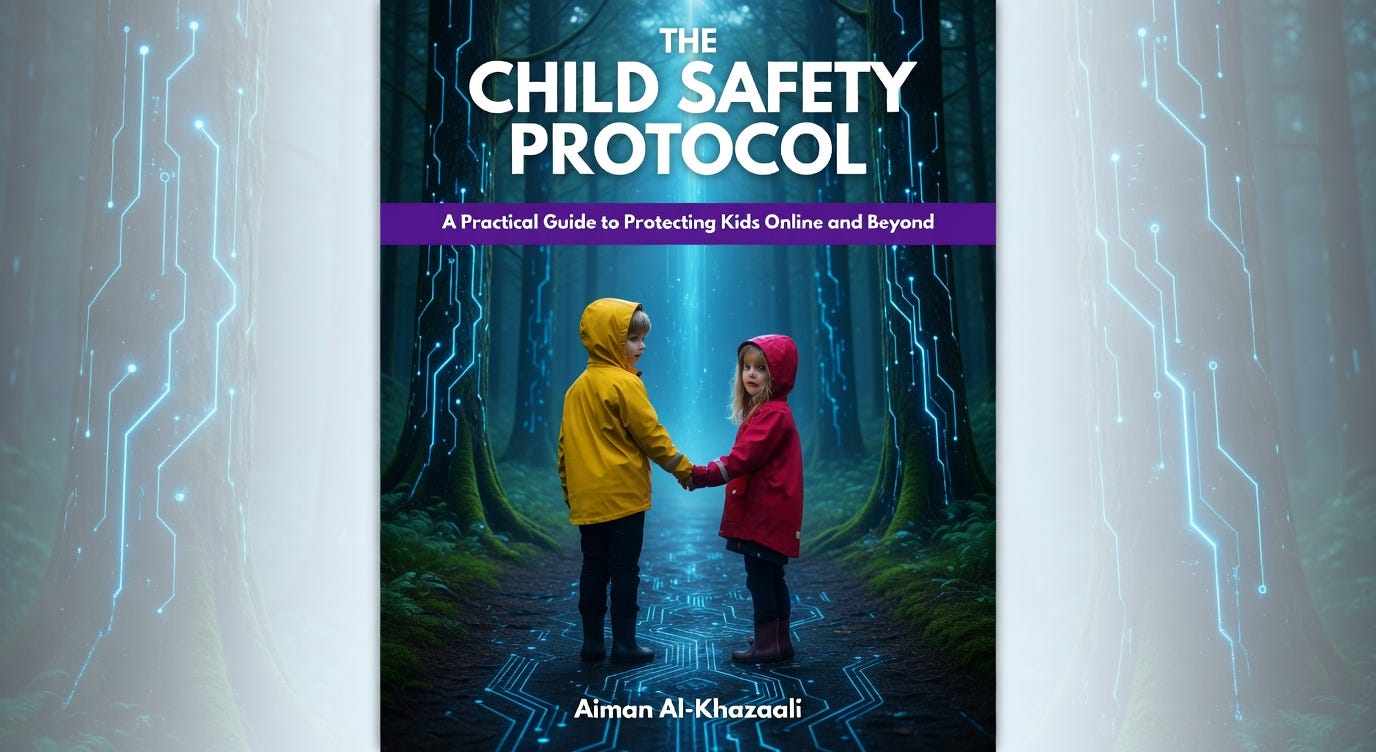
The result of that research is a 69,000-word book manuscript: The Child Safety Protocol: A Practical Guide for Parents to Protect Kids Online and Beyond.
Today, the advance reader copy is finalized, the book is at the editor for a final proofread, and I am officially launching a Kickstarter campaign to fund its printing and publication:
Why Current Advice Fails
The most common piece of advice circulating today is some variation of “keep the lines of communication open.” While essential, treating conversation as your primary (or only) line of defense is a catastrophic error.
The explicit goal of a modern predator’s playbook is to ensure the child does not talk to a trusted adult. A patient adversary will spend weeks or months engineering the specific belief that this particular connection is the exception, that parents wouldn’t understand, or would overreact and take their devices away. Secrecy is the intended endpoint of the process, not an accident.
Relying solely on “the talk” is like expecting your home security plan to hold because your house feels welcoming. It matters, but it isn’t a lock.
Similarly, we are told to trust platform-level parental controls. But when tech corporations openly admit that deploying robust harm-detection tools across end-to-end encrypted or livestreamed content is “prohibitively expensive,” they are revealing their true priorities. Parental controls that merely limit screen time do not alter the fundamental architecture of platforms designed for engagement volume over user safety.
The Protection Model: Defense-in-Depth
As a systems engineer who has spent two decades debugging distributed systems under pressure, I know that you do not protect a vulnerable asset by trying to build a single, perfect wall. Perimeters fail. Software misses things. Judgment lapses under pressure.
In infrastructure security, we solve this through Defense-in-Depth: designing systems with no single point of failure. Attackers have to defeat every single layer; defenders only need one layer to hold.
The Child Safety Protocol translates this engineering logic into a practical, five-layer framework that any household or institution can deploy.
Moving from Panic to Precision
This book contains no fear-mongering, no sensationalist headlines, and no generic platitudes. Fear without function is entirely useless.
Instead, it provides precise, age-based playbooks, tool setup references, checklists, and legal context. It targets what sits directly inside your immediate span of control. We cannot single-handedly force tech platforms to change their codebases today, but we can fundamentally alter the environments our children navigate right now.
To bring this framework to print and get it into the hands of parents, educators, and guardians, I need your help. The writing and editing are done! The printing and distribution phase begins now.
Please consider backing the project, securing your copy, and sharing the campaign with anyone responsible for a child in a digital-first world.
As always, thank you for reading, for your critiques, and for your continued support.
~Aiman A.
Austin, Texas & Rochester, New York