


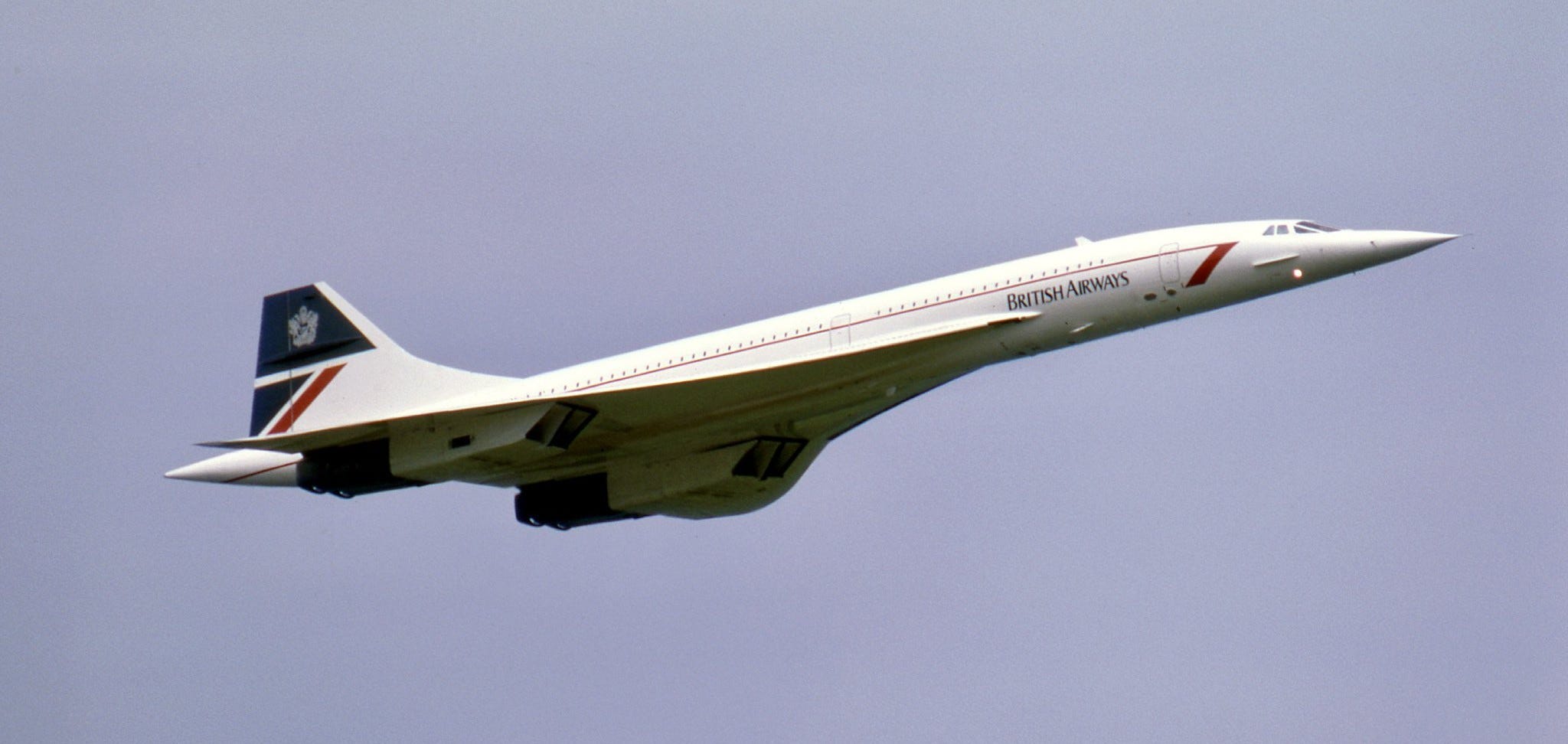
There are birthdays you celebrate with cake, and birthdays you celebrate by breaking the sound barrier. On my birthday in November 2002, I chose the latter.
From the Mundane to the Sublime
My pilgrimage to supersonic flight began, appropriately enough, with the most ordinary of journeys. The Delta regional jet from Rochester to JFK was everything aviation has become in the post-deregulation era: cramped, utilitarian, forgettable. Just another aluminum tube filled with business travelers and weekend visitors, grinding through the autumn sky over upstate New York.
But this wasn't just any connection flight. This was my pathway to history.
At JFK, everything changed. Walking from the gate of that forgettable Delta flight to the Concorde departure lounge was like stepping through a portal between two different eras of aviation. Behind me lay the democratic, efficient, thoroughly modern world of mass air travel. Ahead lay something that belonged in a different century entirely, the 21st century we'd all imagined but somehow never quite reached.
An Audience with Royalty
Concorde wasn't just an aircraft; it was a statement. By 2002, with retirement rumors swirling and ticket prices that could buy a decent used car, flying supersonic had become the ultimate luxury, not just of comfort, but of time itself. The passenger manifest read like a Forbes list mixed with a film premiere guest roster. Business titans who measured their time in millions per minute sat alongside celebrities for whom crossing the Atlantic in half the time meant the difference between making an appearance and missing it entirely.
But there were others too: aviation enthusiasts making their pilgrimage, regulars who sensed their supersonic days were numbered, and people like me, those who had saved and splurged for one perfect moment of technological transcendence.
G-BOAE: Alpha Echo
The aircraft waiting at JFK was G-BOAE, registration Alpha Echo, herself a piece of living history. She was the very first production Concorde to enter service with British Airways, having made her maiden commercial flight in January 1976. By the time I stepped aboard that November evening, she had crossed the Atlantic thousands of times, carrying everyone from business executives to rock stars, diplomats to royalty.
Looking at her on the tarmac, Alpha Echo possessed a beauty that was both elegant and predatory. That distinctive delta wing, the graceful fuselage tapering to a point, the drooped nose that would rise for takeoff, she looked exactly like what she was: a machine designed to slice through the sound barrier as smoothly as a knife through silk.
The Flight of Kings
If the 747 is the queen of the skies, majestic, capacious, democratically carrying the masses, then Concorde was undoubtedly the king. Smaller, more exclusive, faster, and with a presence that commanded respect from every controller and ground crew member who worked around her.
The moment we began our takeoff roll, I understood why. The reheat kicked in with a authority that pressed me back into my seat with a force no subsonic aircraft could match. This wasn't just acceleration; it was a declaration of intent. We were going to outrun our own sound.
As we climbed through 28,000 feet, the reheat engaged again, not with the roar I'd heard during takeoff, but with a purposeful thrust that carried us through the sound barrier and into the realm of physics that belonged to fighter jets and space shuttles. The Mach meter ticked past 1.0, and suddenly we were no longer bound by the same rules as every other passenger aircraft in the sky.
At 60,000 feet and Mach 2.04, the world fell away beneath us. The curvature of the Earth became visible, the sky above turned that distinctive deep purple of the stratosphere, and we settled into supersonic cruise, flying faster than a rifle bullet, yet so smoothly that champagne barely rippled in the glasses.
The End of an Era
What I didn't fully appreciate that November evening was that I was witnessing the end of something extraordinary. By November 2002, Concorde's fate was already sealed, though the final announcement wouldn't come until April 2003. The economics had become impossible, the fleet was aging, and the post-9/11 world had little appetite for expensive luxuries.
Looking back now, more than twenty years later, that birthday flight feels even more precious. We've gained so much in aviation technology, better fuel efficiency, quieter engines, more comfortable cabins, but we've also lost something irreplaceable. When Concorde made her final commercial flight on October 24th, 2003, humanity actually moved backward technologically. Suddenly, the fastest way across the Atlantic was half as fast as it had been the day before.
Back to Earth
The return journey to New York a few days later was on a Delta 777, a fine aircraft, comfortable and reliable. But crossing the Atlantic in seven hours after having done it in three and a half felt like traveling by wagon after riding in a race car. The 777 was subsonic reality; Concorde had been supersonic dreams made manifest.
A Contemporary Returns Home
There's something almost mystical about the timing: Alpha Echo made her first commercial flight in January 1976, and I was born in November of that same year. We were both children of 1976, both products of an era when humanity believed that faster, higher, and more elegant were not just possible but inevitable. By the time I stepped aboard her that November evening in 2002, she had been crossing the Atlantic for almost exactly as long as I had been alive. Twenty-six years of supersonic service, carrying millions of passengers, and finally, on my 26th birthday, carrying me.
No wonder I felt so connected to that particular airframe. We were contemporaries.
Today, Alpha Echo sits in the Intrepid Sea, Air & Space Museum in New York, just miles from where she used to thunder down JFK's runway. Visitors can walk through her narrow cabin, sit in those distinctive seats, and imagine what it was like when she was alive, when her engines roared with purpose and her wings cut through the sound barrier twice daily.
But she's still and silent now, a beautiful artifact of what aviation once achieved and what, perhaps, it might achieve again someday. I've thought often about visiting her again, not as a passenger this time, but as a pilgrim returning to pay respects to an old friend. There would be something poignant about seeing the same aircraft that carried me across the Atlantic at Mach 2.04, now resting in retirement but still graceful, still proud.
The Dream of Speed
There are new supersonic passenger aircraft in development, Boom, Spike, and others promising to bring back the dream of speed. But even if they succeed, they'll be walking in the shadow of what Concorde accomplished over four decades ago. She didn't just break the sound barrier; she made it routine. She didn't just carry passengers; she carried them into the future.
For 27 years, from 1976 to 2003, it was possible to leave London after lunch and arrive in New York before noon. That wasn't science fiction, it was British Airways Flight 001, departing daily.
The King's Legacy
Twenty-one years after my birthday flight, I still remember every detail: the acceleration, the climb, the moment we went supersonic, the view from the edge of space, the profound satisfaction of having experienced something that no one born after 1960 may ever experience again.
Concorde was more than fast, she was elegant, exclusive, and utterly uncompromising. She represented aviation at its most ambitious, an era when engineers and designers reached for the seemingly impossible and made it routine.
The 747 may have been the queen of the skies, democratizing air travel and shrinking the world for millions. But Concorde was the king, regal, powerful, and unforgettable.
Some birthday presents you unwrap and forget. Others, you remember for the rest of your life.
Alpha Echo lives on at the Intrepid Museum in New York, a testament to an age when humanity flew faster than sound and made it look effortless.