


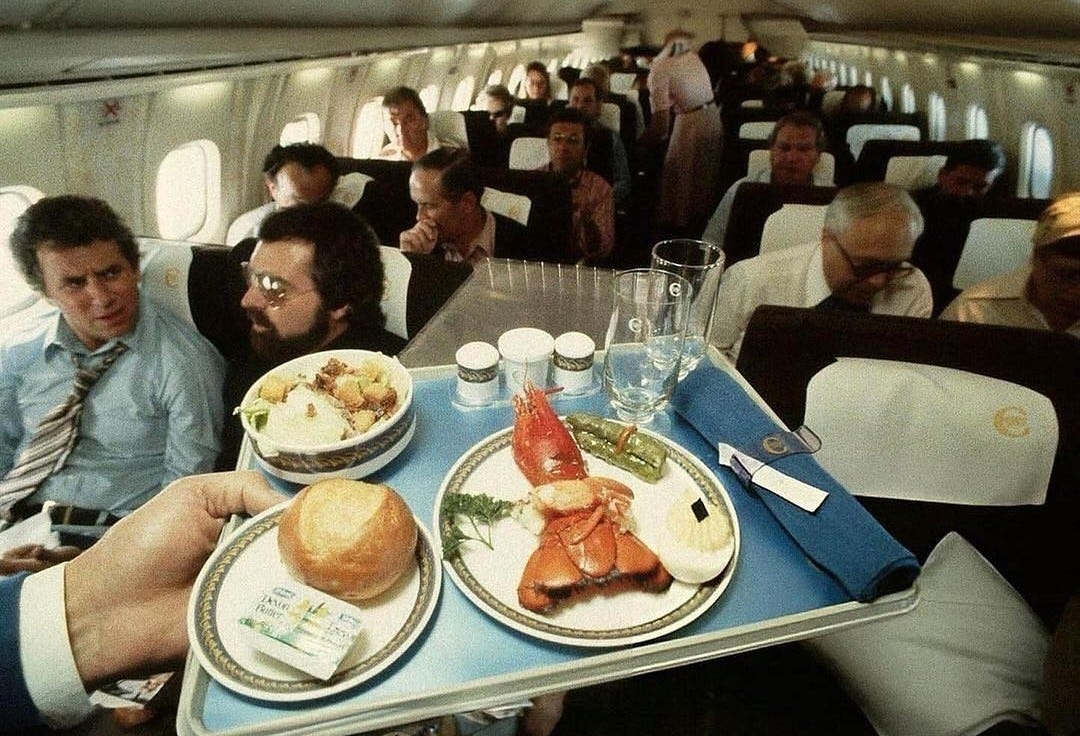
There’s an old photograph I keep (not the one above!): November 2002, boarding British Airways Concorde G-BOAE (Alpha Echo) at JFK. I’m wearing a suit. Everyone else in frame is wearing a suit or dress. Not because it was required, but because that’s what you did when you flew. Especially when you flew supersonic.
Flash forward twenty-three years. The Trump administration’s Department of Transportation just launched a campaign called “The Golden Age Of Travel Starts With You,” complete with a checklist asking passengers basic questions like: Are you dressing with respect? Are you keeping control of your children? Are you saying thank you?
That we need a government campaign to remind people to wear clothes and use basic manners at 35,000 feet tells you everything about how far we’ve fallen.
The Numbers Don’t Lie
The saying goes “you can’t buy class,” and that’s abundantly clear from the 13,800 unruly airline passengers reported by the Federal Aviation Administration since 2021 alone.
U.S. Transportation Secretary Sean Duffy wants to bring “civility” back to air travel. His campaign video contrasts passengers from previous decades, business suits, dresses, courtesy, with modern travelers in pajamas, sweatpants, and bare feet, fighting with each other mid-flight.
“People dress up like they’re going to bed when they fly,” Duffy observed. “We want to push people as we come into a really busy travel season, help people out, be in a good mood, dress up.”
The statistics are sobering. In-flight outbursts have surged 400% since 2019. In 2021, the FAA logged 5,973 unruly passengers, six times the 2020 figure. By 2024, incidents had doubled from 2019 levels. These range from disrupting fellow passengers to outright violence.
“Things aren’t what they used to be,” Duffy said. “Let’s bring civility and manners back.”
What Changed?
I can tell you exactly what happened. We democratized flying and, in the process, convinced ourselves that civilization was optional.
When Concorde ruled the skies, the true king, sleek and fast, while the 747 reigned as the capacious queen, air travel still retained some mystique. You dressed up because you were doing something special. You minded your manners because you were in a shared space with strangers, bound by an unspoken social contract: we’re all in this aluminum tube together, so let’s be civil.
Then came deregulation, budget carriers, and the race to the bottom. Flying became a bus route with wings. Tickets got cheaper. Seat pitch got smaller. And somewhere along the way, passengers decided that paying $89 for a ticket entitled them to behave like they were in their own living room. Or bedroom. Or worse.
The erosion wasn’t just about attire, though showing up to an airport in pajamas is certainly a symptom. It’s about the broader collapse of public comportment, the idea that convenience and price trump dignity and mutual respect.
Secretary Duffy’s Checklist
The Department of Transportation’s “Golden Age” campaign asks five basic questions:
Are you helping a pregnant woman put her bag in the overhead bin?
Are you dressing with respect?
Are you keeping control of your children?
Are you saying ‘thank you’ to your flight attendants and pilots?
Are you saying ‘please’ and ‘thank you’ in general?
Read that list again. These aren’t aspirational goals. These are baseline expectations that our grandparents would have considered obvious. The fact that we need a cabinet secretary to remind adults to say “please” and “thank you” is damning.
“Manners don’t stop at the gate,” Duffy said, a statement that should be unnecessary but apparently isn’t.
The Golden Age We Lost
When I flew Concorde for my birthday, the passenger manifest read like a Forbes list. Business titans, celebrities, people for whom time itself was the ultimate luxury. But it wasn’t just the wealthy regulars who treated the experience with reverence. Everyone did. The aviation enthusiasts making their pilgrimage, the first-timers who’d saved for years for one perfect supersonic crossing, we all understood we were participants in something larger than ourselves.
That aircraft, Alpha Echo, the first production Concorde to enter British Airways service, wasn’t just a machine. She was a statement about what human engineering could achieve when we aimed high. Every controller and ground crew member treated her with respect. Every passenger dressed appropriately, not because of some written rule, but because the moment demanded it.
We weren’t just flying. We were participating in the apex of aviation achievement.
Concorde retired in 2003. We didn’t just lose supersonic travel; we lost the last bastion of aviation as occasion rather than obligation.
Can We Get It Back?
The DOT campaign aims to “jumpstart a nationwide conversation around how we can all restore courtesy and class to air travel.” It’s a worthy goal, especially heading into the busiest travel period of the year. AAA projects 81.8 million Americans will travel at least 50 miles from home over Thanksgiving, from November 25 to December 1.
“Let’s be merry this holiday season as we fly!” Duffy urged. “Dress up to go to the airport, help a stranger out, and be in a good mood. We can bring civility back, it’s as easy as that!”
But is it that easy?
The challenge isn’t just behavioral, it’s cultural. We’ve spent two decades training passengers that flying is something to endure rather than enjoy, that minimum price trumps maximum dignity, that personal comfort supersedes public decorum.
You can’t resurrect the golden age through PSA campaigns alone. But you can start by acknowledging what we’ve lost and why it matters.
The Lesson from 60,000 Feet
I still remember the moment Alpha Echo rotated off the JFK runway, the Rolls-Royce Olympus engines roaring with reheat as we climbed into the November evening. Inside that narrow cabin, passengers settled in with quiet anticipation. No one was fighting over armrests. No one had their bare feet on the bulkhead. No one needed to be reminded to thank the cabin crew.
We understood that we were experiencing something rare. And we behaved accordingly.
The thing about the golden age of travel isn’t that everyone flew Concorde or that only the wealthy could afford tickets. It’s that flying itself was treated as an event, a small adventure, something that warranted your best behavior and at least business casual attire.
We traded that sense of occasion for $89 fares and the right to wear pajamas. In the process, we created a airborne environment where violence has quadrupled and basic courtesy requires a federal campaign to restore.
Maybe Secretary Duffy is onto something. Maybe we do need to dress up again. Say please and thank you. Help the pregnant woman with her bag. Treat flight attendants with respect instead of viewing them as obstacles to our personal comfort.
It won’t bring back Concorde, nothing will. The king is gone, relegated to museums where children press their faces against the glass, marveling at a needle-nosed delta-winged artifact from a more ambitious era.
But we could at least try to fly like we did when the king was still in the air.
The author flew British Airways Concorde G-BOAE from JFK to Heathrow in November, 2002. Alpha Echo is now preserved at the Intrepid Sea, Air & Space Museum in New York, where she rests in dignity, which is more than can be said for some passengers.